Thursday, August 23, 2012

Coffee, coffee, coffee, tea


As far as I am concerned, there are two kinds of mornings: mornings that start with coffee and mornings that start with tea.

Starting off a morning with coffee for me is nearly the same as ending a sentence with a period, wanting tacos for lunch/dinner/breakfast, and wearing the color blue. Meaning, it happens almost every day. A typical day following a cup (or two or three) of coffee involves schoolwork, work work, and an overwhelming desire to nap. These days include deadlines to be met, papers to be written, and a hefty dose of stress. In other words, the coffee consumed in the morning (and afternoon) acts as a life source. It keeps me from wearing mismatched shoes and reminds me that chocolate is not an appropriate breakfast… by itself. (If it is in the form of a muffin, donut, croissant, and/or cookie, then by all means.)

A day that begins with tea is a whole other ballpark. Less caffeine means less work, obviously. These days include leisure reading, casual laundry, and long bike rides. Maybe I’ll run some errands, go to the bank, or sort through my junk e-mail. Or maybe I’ll rifle through the pantry for the third time before eventually deciding on whole wheat toast and blueberry preserves for breakfast. In any case, the day is sure to end with a healthy balance of productivity and browsing on Pinterest for the best Gilmore Girls quotes.

Can you guess what was in my mug this morning?

Thursday, March 8, 2012

Fifth Avenue, 5 A.M. by Sam Wasson

Breakfast at Tiffany's is one of my favorite movies, ever.

First of all, there's the cast: Hepburn, Neal, Peppard, Ebsen, etc., the fashion (thank you, Edith Head and Givenchy), and the writing.

I've read the novella the movie is based on by Truman Capote, and loved it too, but it made me wonder: how did such a risque story about a call girl and a gay man turn into a Hollywood romance that also features Mickey Rooney as a slightly (very) racist portrayal of an Asian landlord? Why does Holly Golightly eat a danish outside Tiffany's as opposed to, I don't know, an ice cream cone? These are the kinds of questions I want answered.

Thankfully, Sam Wasson's book Fifth Avenue, 5 A.M. does just that. Wasson explains how Capote originally wanted Marilyn Monroe to play Holly Golightly, but was rejected because that the role was too scandalous; how no one got along with George Peppard, especially Patricia Neal; and of course, how the signature little black dress changed fashion forever.

Fifth Avenue, 5 A.M. also looks into the whole film making process of the 1950s/60s. Getting the right director, screenwriter, actor, actress, composer, costume, filming location, etc. is more difficult than I truly realized. Also, having them all get along isn't so easy, either. An example of such controversy: at one point, Audrey was so adamant about keeping the song "Moon River" in the movie that she yelled at a studio executive, who suggested they cut it out, "Over my dead body!" and I'm pretty that had never, ever happened before Breakfast at Tiffany's. Not Audrey disagreeing with an executive, but her yelling at anyone, ever.

Even if you've only seen Breakfast at Tiffany's once, or not at all (is that possible?), Wasson's book offers an intimate look inside the minds of some of Hollywood's best directors, actors, writers, and producers. I highly recommend reading it, whether you're an Audrey devotee or simply interested in how such a revolutionary movie came into being. Either way, it's definitely worth checking out.

Tuesday, January 10, 2012

The Help by Kathryn Stockett

Fact #1: Despite the lack of attention I've given my blog as of date, I have not in fact given up reading. I just figured my friends had better things to do than read dry, academic commentaries on Beowulf or Paradise Lost.
Fact #2: I'm probably the last person on earth to have finally read Kathryn Stockett's The Help.


Ever since I heard the buzz surrounding the novel and eventually the movie, I had been meaning to pick up a copy and read. I mean, NPR commented that it's one of the most important books since To Kill a Mockingbird, which, despite one's thoughts of NPR, are some pretty words to live up to.

Thanks to my lovely best friend, I snagged a copy and started reading as soon as finals were over. The story revolves around three main characters: Skeeter, a young college graduate who's more interested in journalism than marriage; Aibileen, a wise and maternal maid who works for Skeeter's friend; and Minny, Aibileen's closest friend despite her bad temper and "sass-mouth." Skeeter wants to do more with her life than just settle down and keep house, so she decides to write a book about maids in Jackson, Mississippi with the help of Aibileen, Minny and various other maids. Set in the early 1960s, the book examines the relationships between white and black women as well as racial prejudice and gender roles of the time.

I was very interested in the story and plot, however I was a little disappointed with Stockett's writing style. She chose to portray each point of view through first person present, and for Minny and Aibileen's characters, that meant using an ethnic lingo that to me, seemed very forced and unnatural. I understand that the story takes place in the South, but if the maids have accents why doesn't Skeeter? I'm not about to call Stockett racist by any means, but it certainly is risky on her part.

Despite my criticism, I thoroughly enjoyed the story and the characters Stockett created. Miss Hilly is an absolute villain that I love to hate, and Aibileen's quiet and patient demeanor is admirable. I'll be interested to see what Stockett writes in the future as well as note how her writing style matures and develops.

Saturday, July 23, 2011

Sisterhood Everlasting

I'll be the first to admit it - I'm a huge fan of Ann Brashares' Sisterhood of the Traveling Pants series. In fact, I'm almost certain Brashares closely studied me and my best friends when creating Lena, Bridget, Tibby, and Carmen simply because they were so incredibly relatable. So, when I found out Brashares had written a sequel to the series, set ten years after the last book, I couldn't wait to read it.

The girls are ten years older, 29, and work, love, and life have taken them in different directions. Tibby has moved to Australia with boyfriend Brian, Carmen leads a fast-paced, glued-to-iPhone-life in New York as a TV actress, Lena teaches at Rhode Island School of Design quietly and contentedly, and Bridget is in California with Eric still as reckless and restless as ever. While their friendship lives on, despite hasty phone calls, few visits, and distracted lives, it's clear to them it's not the same. So, when the Carmen, Lena, and Bridget receive Tibby's invitation to reunite in Greece, they jump at the chance to see one another and relive their younger days.

This book isn't like the others in the series. It's not as lighthearted, as the girls have to deal with tragedy, loss, love, marriage, children, careers; real life. It's a must read by anyone who's grew up with the Traveling Pants as it's not only a tribute to the Sisterhood, but to real, honest-to-goodness friendship.

Wednesday, July 13, 2011

The Screwtape Letters

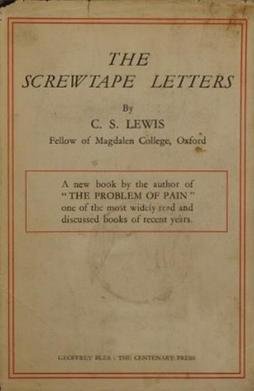
File:Thescrewtapeletters.jpgToday I finished reading The Screwtape Letters by C.S. Lewis. First published in 1942, the story takes shape in epistolic form - a series of letters written by a senior demon named Screwtape and addressed to his nephew, Wormwood, a young "tempter." The letters concern a human man, only referred to as the "patient." Screwtape advises and critiques Wormwood as he attempts to encourage sin and thus lead the patient away from the Enemy.

From this morally reversed point of view, individual benefit is the ultimate goal and non-sins are twisted into whatever will help lead the patient to Hell. Faith and prayer are alright as long as there is spiritual righteousness, and unselfishness is encouraged as long as the patient is acutely aware that he is, at that moment, being unselfish.

The book is dedicated to J.R.R. Tolkien, who warned Lewis of delving deeply into the craft of evil. Lewis would later comment that though the end result was enjoyable, he would never write a "letter" again.

The copy that I read was given to me by a good friend, who was given to her by a friend. I think I'll pass this along to anyone willing, as it is a must read.

Tuesday, June 7, 2011

The Girl Who Chased the Moon

I don't normally read books with covers that look like this.

I don't usually read books with titles like The Girl Who Chased the Moon.

...but sometimes it's nice to read about magical wallpaper and giants and whimsical baking. Just sayin'.

However, whether due to unrealistic expectations or what, I was disappointed with this chick lit. In this book, Allen tends to tell a lot instead of showing a lot, which drives me up a wall. If I get the feeling that a situation is awkward between the characters, I don't need an author to pipe up and say outright, "it was awkward." And another thing: there was way too many women freaking out and seeking comfort in a man/teenage boy's arms. I'm not buying into this idealistic, damsel in distress sense of romance. Seriously.


I also wouldn't normally tell you I've read more by this author. Probably because they're equally girly and cutesy, and not nearly as intellectual as Dostoevsky. But, in this moment of pure and utter honestly, I thought I'd let you know that this isn't as good as Allen's other work.


I hope this doesn't change your view of me too much. I'm still that feminist chick who read Bleak House

Monday, May 30, 2011

The Hitchhiker's Guide to the Galaxy

First of all:

DON'T PANIC.

Second of all, I recently finished reading Douglas Adam's The Hitchhiker's Guide to the Galaxy. For anyone who knows me, science fiction is not usually my usual go-to genre. However, I had seen the movie years ago and I've been told countless times that Douglas Adams is pure and utter genius. And, it turns out he is. In this Sci-Fi spoof, Arthur Dent travels through the galaxy with his alien friend, Ford Prefect, after the Earth has been demolished in order to make way for an intergalactic bypass. Aided by the Hitchhiker's Guide to the Galaxy, they encounter planet builders, a depressed robot, and the answer to Life, the Universe, and Everything. The whole book is filled with Adam's clever wit and comedic dialogue, and I'm looking forward to eventually reading the rest of the series.

Wednesday, May 11, 2011

Jane Eyre

The quintessential Gothic romance, Charlotte Brontë's Jane Eyre has been on my reading list for some time. I'm a fan of her sister's infamous work, Emily Brontë's Wuthering HeightsPlus, with the new movie out, I had even more reason to start reading it.

At first glance, Jane's life is inherently depressing. Orphaned at a young age, she's taken under the care of her uncle. However, he dies shortly after and his haughty, jealous, and mean-spirited wife, Mrs. Reed, plays the role of Cinderella's stepmother and altogether makes Jane's life miserable. The haunting account of the "red room" is vivid and disturbing, as is the terrible treatment received by her bratty cousins. Unlike Cinderella, unfortunately, Jane is not eventually rescued by a prince, but is instead sent off to Lowood Academy, and so her dreary life continues.

Were the story told by any other character than Jane Eyre, it would more than likely be way too depressing to read. But Jane's optimistic and heavenward view of life and human nature seems to mature through her pitfalls and obstacles. I have to admit, I was impressed by her sense of theology and overall sense of God. In particular, her response to Mr. Rochester stood out to me:


"A wanderer's repose or a sinner's reformation should never depend on a fellow creature. Men and women die; philosophers falter in wisdom, and Christians in goodness: if any one you know has suffered and erred, let him look higher than his equals for strength to amend, and solace to heal."


In addition, Jane Eyre is filled with allegory: from the lightning-struck chestnut tree to attempted arson, the abundant symbolism and imagery provide even more room for thought. 


If you haven't already, go read Jane Eyre. It's a classic for a reason, and there's certainly never a dull moment (or page). 

Saturday, April 2, 2011

The Great Typo Hunt

Let me say firstly, this post is way overdue. I started and finished The Great Typo Hunt last month and while I enjoyed it tremendously, never got around to blogging about it. 

Secondly, Jeff Deck and Benjamin D. Herson are my heroes.

Jeff DeckBenjamin D. Herson


The true account of two guys traipsing around the country in search of and correcting typos is the premise of this book, but it's also so much more. Before I get ahead of myself, here's the gist: Jeff Deck is a science fiction nerd (note: "nerd" is used as an endearing term) who decides one day, after being bombarded by spelling errors, punctuation gone awry, and article/noun disagreements displayed on public signs, businesses, and store fronts, that it's time for a change. He and Benjamin D. Herson traveled across the country fixing everything from restaurant signs to museums to National Park property -- where they meet friendly store clerks, stubborn cafe owners, and unhappy authorities. 

Deck and Herson discovered something very significant along the way: America wasn't just having trouble with grammar; our country was lacking in the communication skills department. After all, language is used to convey, transcribe, and send a message. If society doesn't have a firm grasp on the basics, how are we to thrive (both socially and economically)?

There you have it. The Great Typo Hunt is about more than just typos, it's about communication. I definitely recommend reading this one.

Saturday, March 5, 2011

Bleak House

As of a little over a week ago, I finished Bleak House by Charles Dickens. My first college English professor  suggested I read it years ago, as it's regarded as Dickens' best work. I'll also have you know, it's regarded as his longest work as well (my copy weighed in at 965 pages - seriously, it's thicker than my Bible).

It's long.

Though it's composed of many side stories and characters, Bleak House revolves around Esther Summerson, an orphan with a dark past, whose life is well, bleak. Until she and two others: Ada Clare and her cousin, Richard Carstone, are sent to live with John Jarndyce. Jarndyce is involved in an long, ongoing Chancery Court case Jarndyce v Jarndyce. If successful, Jarndyce could win a great deal of money, but he's not hopeful and considers the case a burden more than anything else. Soon, Richard becomes involved in the case, eager to win some of the inheritance, but is dissuaded by his family and friends as he's known for being irresponsible with his finances. The case is a matter of disputed wills, and has run through generation after generation without settling. Not only is it seemingly pointless for Richard to become involved, but distracting from his love interest, Ada.

Bleak House is filled with numerous other characters, some are which described as his best ever: Lady Dedlock, Sir Leicester, Mr. George, and many others. Together, the characters and stories work to showcase some of the absurdities of 19th century English law and society. Dickens goes to prove that the legal system and those in it are corrupt and greedy and class divisions are not what they seem, with "do good" upper class attempting to fix the lives of others who have never asked for such help in the first place.


There are 40 illustrations in Bleak House, and all were done by Hablot Browne, better known as Phiz.

Remember the part about Bleak House being long? Well, it still is. But after reading it, I couldn't believe just how much Dickens fit into that one book. There are just so many interesting side plots and characters, that looking back on it, it doesn't seem as long as it could've been. But maybe this is just hindsight bias.

Overall, if you have a lot of free time (or even if you don't), read Charles Dickens' Bleak House.

Friday, December 31, 2010

2010: A Year of Excessive Reading

I'd like to think this past year has been productive. Somehow amidst knocking out 38 credits, getting a job, and still maintaining a social life, I managed to read 19 books this year. Am I bragging? Maybe. If you consider reading a plethoric amount of books a "cool" thing, well then, get ready for a lot of coolness, because I'm about to list them all:

1. Please Kill Me: The Uncensored History of Punk by Legs McNeil. From the Velvet Underground to the Sex Pistols - this book covers nearly every influential Punk band from the late 60's through the 80's. It's awesome, go read it. Now.
2. The Sugar Queen by Sarah Addison Allen. It's cute, it's chick lit, it's got candy and romance.
3. Garden Spells by Sarah Addison Allen. Equally cute and chick lit, but substitute candy with magical cooking.
4. Nightlight: A Parady by the Harvard Lampoon. I despise Twilight, therefore I love this.
5. Crime and Punishment by Fyodor Dostoevsky. I will never spell his name right without looking it up beforehand, but I really enjoyed this regardless.
6 - 11. Scott Pilgrim 1 - 6 by Bryan Lee O'Malley. I refer to them as comic books, but for the sake of argument I'll call them graphic novels (even though they're totally synonymous, Micah). These, ahem, graphic novels are fun reads and were a great precursor to the movie.
12. Girls in Pants by Ann Brashares. Guilty pleasure? Yes. Nostalgic and memory filled? Yes and yes.
13. A Clockwork Orange by Anthony Burgess. I love getting books as presents, especially when they're awesome like this.
14. Diary by Chuck Palahniuk. He's weird and twisted and writes weird and twisted books, simply put.
15. Anthem by Ayn Rand. I love Ayn Rand; I love this book.
16. Much Ado About Nothing by Shakespeare. Normally I don't like to count assigned reading as extracurricular reading, but since I read the whole play, I figured I may as well. Plus, I like Shakespeare.
17. The Riddlemaster of Hed by Patricia A. McKillip. I feel a little cheap putting this on my list since I haven't actually finished it yet. Yikes.
18. Hotel by Micah McFarland. Yes, this is totally going on the list. My boyfriend wrote a novel, and I read it and helped edit it. I can't wait to re-read it when it's finished.
19. Bleak House by Charles Dickens. Okay, so I haven't finished this one yet, but I plan on finishing it before school starts on the 10th. I'm currently at page 203 of 936. I can totally finish it in 10 days. Right?

So there you have it. I already have a few books lined up for 2011, and I can't wait to get started. Thanks to everyone and anyone who bothered to read my bibliomania-filled posts this year, look forward to future attempts in the new year.

Saturday, November 6, 2010

Anthem

I have a bit of a crush on Ayn Rand.

It all started when I first picked up The Fountainhead when I was about 15. While most kids my age trudged through Atlas Shrugged as a school assignment, I was fascinated by Ayn right from the beginning (probably inspired by watching an episode of Gilmore Girls). And immediately after reading The Fountainhead, I discovered the 1949 film classic by the same name, starring Patricia Neal and Gary Cooper (and with a screenplay written by Ayn Rand herself). I was in love.

As shameful as it is, I had never read any of her other works. (With Atlas Shrugged weighing in at 1,368 pages, who wouldn't be a little intimidated?) So, when it was suggested by a particular someone that I read Anthem (a mere 100ish pages or so), I did. And despite its small size, it's brilliant.


Anthem, a novella first published in 1937, is about a dystopian, highly collectivist future in which mankind has entered another dark age, as a result of socialist thinking. The word "I" has completed disappeared from their language. Instead of names, everyone is referred to by numbers. Equality 7-2521 is the hero of the story, and is "cursed" with curiosity and an unwillingness to submit himself completely to others. Equality 7-2521's struggle for individuality is pretty similar to most of Ayn Rand's works, but it doesn't make it any less brilliant.


For the record, Ayn Rand is a political nut job. But she's also a literary genius. So, go make my day and give her a try. Seriously, you won't be disappointed.

Tuesday, October 26, 2010

Diary

"We're all of us a million bits put together in the right way..."

I like Fight Club. I like Chuck Palahniuk I like weird stories about slightly deranged struggling artists who are somehow connected to a ludicrous conspiracy. (I also like free books my sisters buys for me.)

So, I figured I'd like Diary. And it turns out, I do. Maybe not as much as Fight Club, but that's what I get when I read Palahniuk's best work first. Anyway, Diary is about Misty Wilmot, a once talented artist who ends up working as a maid in a hotel while dealing with her comatose husband's cryptically heinous messages left inside sealed walls of homes of angry owners. Eventually she takes up painting again - but she soon figures out this sudden burst of creativity is less inspired than it is
coerced.

The plot is definitely weird. The writing is great, and I love all the art jargon and art history references used throughout the story. Overall, it's a fun read, in a twisted sort of way.

Wednesday, September 1, 2010

A Clockwork Orange

It's apparent by the length of time since my last post that school, homework, best friends moving away, cars breaking down, and sleep are interfering with my pleasure reading. I hate when that happens.


But, I digress. I just finished A Clockwork Orange by Anthony Burgess, a gift I got for graduation. I admit, I didn't really know too much about it before reading it, but I quickly learned it's a very allegorical, political, and linguistically fascinating book. First off, the Nadsat slang. It's Russian-influenced which I find coincidental considering I just read Crime and Punishment. At first it's like reading a bunch of made-up words (probably because most of them are), but through context the slang makes complete sense. I love the correlation between the "brainwashing" use of Nadsat language and the government-issued brainwashing of Alex, the anti-hero and narrator of the story.


The main theme of the book is free will - is it better to have a choice and do wrong, or be forced to do good? Because the moral lesson is so apparent, Burgess dismissed A Clockwork Orange as too didactic to be artistic, which I disagree with. Maybe it's because I never tire of a good, satirical, dystopian novel about the fundamental importance of moral choice. Or maybe it's because now I want to use words like "droog" and "slooshy" in everyday conversation.


As for the title itself, it's supposedly Cockney in origin but I think Burgess defined it best as, "...the application of a mechanistic morality to a living organism oozing with juice and sweetness."


Fascinating, no?


-Lizzy

Monday, August 9, 2010

Crime and Punishment and Jason Mraz

First and foremost, I'm not a blogger by any means. I've always admired those who could write a daily ditty about their thoughts on anything from world politics to what they ate for breakfast without any inhibition. I mean, I've always enjoy writing, but my works have been confined to either research essays or journal entries. I think this will be a happy medium.

When it was first suggested that I start a blog, my first thoughts were hey, I could use it to sort of keep track and criticize the books I read, along with other things. So that's what I'm going to do - starting now.

I just finished Crime and Punishment by Fyodor Dostoevsky the other day, and I have to say, whoever decided that I'm a fast reader is dead wrong, because I started this book months ago. (In my defense, I also read about five books in between starting Crime and Punishment and finishing it, so there.) Honestly though, I'm glad I didn't rush through it. The characters, themes, dialogue, and philosophical ideas are a lot to take in. I loved the way Dostoevsky really allowed the reader to get inside the mind of Rodion Raskolnikov Romanovitch and wrestle with his justification of his actions. Even though the story could be considered a thriller, this isn't a typical whodunnit. The who, what, where, and how are explained from the beginning - but it takes the rest of the novel to figure out the why. The way he compares his killing of the old pawnbroker to Napoleon's conquests and imposing his own will on "the natural order" is definitely thought provoking and unnerving.


I think one of my favorite things about this book is that even though it was published in 1866 Russia, the entire concept is so modern and relevant. I think this book definitely deserves a re-read whenever I get the chance.

Before I wrap this up, I think a little explanation behind the title of this blog is necessary. It's from one of my favorite Jason Mraz songs, On Love In Sadness. The whole lyric goes: "I listened in through hallways and thin doors/Where the rivers unwind and the rust and the rain endure."


I feel like there should be a signifcant and moving story behind why I chose that song for inspiration for titling my blog, but there's not. I just really love the lyrics and the meaning behind them. They're about not letting life make you jaded, always appreciating the love you have in your life. And before you call me a hippie, I definitely think this can apply to God's love as well. Actually, you can go ahead and call me a hippie anyway.


- Lizzy